‘Write with Copilot’, urges the computer. I ignore it, bristling. Why do I need a co-pilot if I’m not flying a plane?
I never invited this thing in. It’s galling that this intrusive bot assumes it is a superior writer to me. I’m a professional writer, who honed my craft on manual typewriters in a newspaper office in a pre-digital age. Back then, in the late eighties, I had nothing but my brain to guide me. There was no Internet to consult.
So – this thing has a nerve, assuming it is superior. Especially given that every single thing it writes is plagiarised. It is, intrinsically, incapable of original thought.
Using AI in copywriting
‘Learn how to use AI without corrupting your craft’ was the line taken by an online course I enrolled on recently. ‘Work with it, instead of trying to fight it.’
The course was all about how to use AI for research, for structure, to spellcheck, sense check, factcheck, but not to write. Never use it to write. Why? Because we’d all be hastening the process of doing ourselves out of a job.
I get job alerts for copywriting jobs, which, these days, mostly look like this:
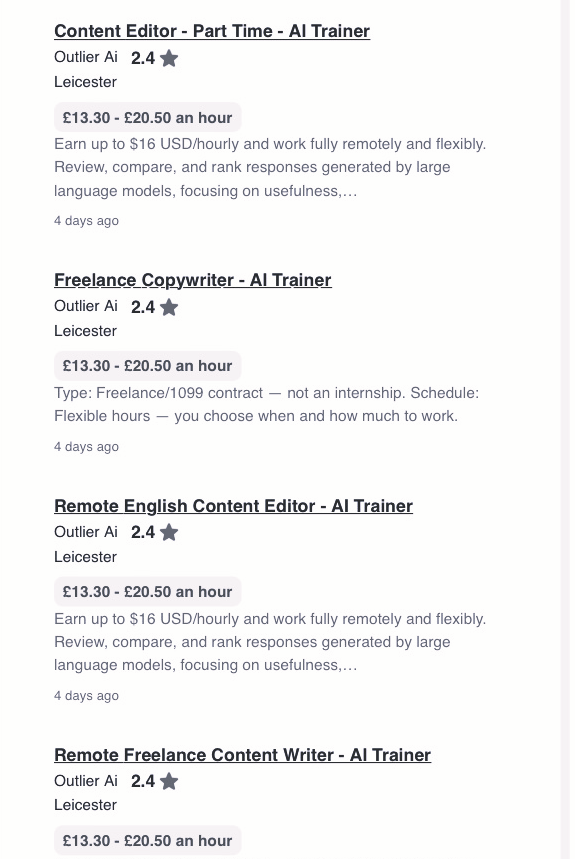
There are, seemingly, thousands of opportunities for copywriters to train AI models. They don’t pay well, but people take them, even though by doing so they’re the proverbial turkeys voting for Christmas. But if you can’t beat them, should you join them?
It’s tempting, when time is tight, and deadlines loom, to turn everything over to the helpful bot. See what it makes of our words. Let it do the donkey work. And then, tweak it back to something that looks like a human could have written it.
Generating ideas
When I’ve attempted this for copywriting purposes, what’s come back is too cliched, with not enough nuance. I confess to using Chat GPT on occasion for PR projects when I’m low on ideas. Much as in a pre-AI world I might google others’ posts, borrow a word here or a phrase there, then jumble it up so it looks original. Isn’t that what everyone does? That’s all AI is doing, after all. Only quicker. Much quicker.
For research, it cobbles information together in super-human nanoseconds. That’s what it’s good for. But you do have to watch out for it. AI hallucinates. Gets its facts wrong. It is, after all, only as good as the information it finds out there, and unless you instruct it to ‘think carefully’ it can be lazy.
Using AI in creative writing
But when I’m working creatively, I don’t want this bot anywhere near my writing. Any more than I’d want a tutor, another author, or an editor to write my work for me. My work is mine alone.
So I’ve turned off the co-pilot on the computer I use. And I mostly write stuff longhand, initially, which is how I am writing this blog post. In a notebook. By which I mean an old fashioned pad of A4 lined paper. You can’t beat it if you want to avoid distraction.
Pitfalls of reliance on AI
But I worry about AI. That it will render us all incapable of stringing a sentence together. That it will usher in a new age of illiteracy. Already, so the soothsayers of doom allege, it’s shrinking the brains of those who come to rely on it.
Being the age I am, most of my portfolio was created before this thing existed. The fact that I can write using only my brain is indisputable.
A lost skill?
But what of the generation now emerging? How can they resist the narrative that tells them the bot can do it better? And, even if they do develop the craft of writing, unaided, how can they prove what they’ve created is all their own work? Will writing become a lost skill, like basket weaving or an ancient woodland craft? The province of a few enthusiasts or those of us left who are old enough to remember how to do it?
Who benefits from the AI revolution?
It’s a revolution, they say. And anyone who opposes its relentless march is like the Luddites of old.
One thing seems certain, it will probably only benefit half the world, if that. The child I sponsor in Malawi will doubtless still struggle to walk four miles to school, her mother drawing water from a well some distance from their home.
There’s a real danger this revolution will only serve to make the divide bigger, the ultra-rich even wealthier… Not to mention its environmental impact. AI, we’re told, is very very thirsty.
And as it usurps jobs, rendering skills redundant, won’t this lead to mass unemployment, which not enough people seem to be talking about…
Useful tool or scourge?
There are, undoubtedly, positive uses for AI – advances in medical science being among them. But there are also uses that are frivolous, abusive, or downright dodgy.
Zelda Williams, daughter of the late actor and comedian Robin Williams, spoke out after being bombarded by AI-generated deep-fake content featuring her late father.
“And for the love of EVERYTHING, stop calling it ‘the future,’ AI is just badly recycling and regurgitating the past to be re-consumed. You are taking in the Human Centipede of content, and from the very, very end of the line, all while the folks at the front laugh and laugh, consume and consume.”
AI and the publishing industry
I wrote another blog post on this back in 2023, but the world has moved on since then, and AI-produced dross now floods Amazon – much of it non-fiction or genre fiction, which lends itself to more a more formulaic approach.
The publishing industry is still at a crossroads regarding AI, with publishers having to decide where they stand.
Maintaining ethical practices
Our publisher, like others, has had to take a stance, and issued a statement in its contracts which includes the following: “We will not publish AI-written work, nor will we use AI artwork inside/covering the book, or stable-diffusion work for marketing.”
It also pledges to maintain ethical practices regarding the use of AI, to protect the author’s intellectual property:
“We firmly believe in the value of authors’ talent, skill, hard work and individual creativity. As such, we have taken a stand against feeding any author’s work into AI systems, including LLMs. By refusing to use AI in this manner, we ensure that an author’s intellectual property remains as intact and uncompromised as possible.”
While the relationship between my publisher and its authors relies on trust, in other setups authors may be asked to issue a disclaimer, confirming that the work they are submitting is all their own, and not AI- enhanced.
Some publishers, however, are embracing AI and encouraging authors to use it in the editing process.
Creatives fight back
Last year the Society of Authors put together a response to a UK government consultation which proposed waiving copyright laws to enable tech companies to use authors’ work without permission to train its models.
Under the proposals, the onus would be on authors to opt out, rather than the tech companies being required to ask permission or – God forbid – pay people for using their work.
‘Make it fair’
The SOA joined many others across the UK’s creative industries to launch the ‘Make it Fair’ campaign, highlighting how their content is at risk of being given away for free to AI firms, arguing this posed an existential threat to creatives, and that the government’s proposals would effectively legitimise content theft.
The impact on creative businesses and individuals throughout the country – who collectively generate over £120 billion a year towards the UK economy – will be devastating if this continues unchecked, or worse still, if the government legitimises such content theft.
Consultation
As I understand it, the consultation has not yet delivered any definitive outcomes. Perhaps – hopefully – the government was blindsided by the strength of the response, which was wide ranging, covering all forms of art including visual arts and music.
As Sir Paul McCartney told the BBC: “You get young guys, girls, coming up, and they write a beautiful song, and they don’t own it, and they don’t have anything to do with it. And anyone who wants can just rip it off.”
“The truth is, the money’s going somewhere… Somebody’s getting paid, so why shouldn’t it be the guy who sat down and wrote ‘Yesterday’?”
Why indeed? It’s not like the tech companies can’t afford to pay.
Legal action
Meanwhile in the US it’s encouraging that a class action was taken by authors and publishers who claim their copyright was infringed by Anthropic PBC, which used books from pirate websites Library Genesis (“LibGen”) and Pirate Library Mirror (“PiLiMi”) without permission to train their Large Language Models.
The Judge in this case approved a $1.5 billion settlement with authors in the largest publicly reported copyright recovery in history.
A divided world
The world seems to be divided between those who welcome AI with open arms and those who remain sceptical. I have a friend who is an early adopter, who embraced Chat GPT as soon as it became available. We called it his new best friend. He consults said friend on anything from health issues to motor diagnostics.
However, there have been instances where the bot’s responses are demonstrably inaccurate. When this is pointed out, it gets a little defensive, then, hopefully, revises its data for future searches.
AI ‘hallucinates’
We’ve all heard about the holiday-seekers who use AI to plan their trips abroad, only to turn up at a destination to find it doesn’t exist. Clearly, we have to treat what the bot tells us with caution, and check the facts it gives us.
More concerning, is that people are reportedly using it to make life decisions, like whether to break up a relationship, or who to vote for in an election, especially alarming when you consider the potential for bias.
In an AI-dominated world, why bother writing?
I’ve heard authors say that the very existence of AI is cramping their style, rendering the rollercoaster process of writing, submission and frequent rejection seem even more hopeless.
Why spend a year crafting a novel when the bot can do it in seconds?
Writing boosts wellbeing
But good writing cuts to the essence of human experience, resonating at a visceral level. How can a bot emulate this, other than by plagiarism?
It’s well documented that creative writing boosts wellbeing, and is therapeutic in itself. There’s a unique satisfaction in crafting a piece of writing, knowing it is all your own work, however raw and unpolished it may be.
Authored by a human.
The Society of Authors and others have called for a system of labelling – similar to that used in the food industry – which would clearly state if a piece of writing is authored by AI. The powers that be have been slow to respond. But in the meantime, the Society is developing its own ‘authored by a human’ hallmark.
I can categorically state that this blog post was authored in its entirety by a human!
